Another Kurdish Setback in Syria
The Kurdish-led Syrian Democratic Forces (SDF) appears to be at the brink of irrelevance after suffering a series of military and political defeats in northern Syria over the past two weeks. Frustrated with the failure of Kurdish leadership to implement a deal that would have seen the integration of the SDF into Syria’s military, the government launched a campaign to oust the SDF from Aleppo. Syrian government forces pressed their advantage over the past weeks as negotiations failed to reach their desired goal. The government offensive, assisted by Arab tribal defections from the SDF, gained the provincial capitals of Deir ez-Zor and Raqqa advancing to the outskirts of Hasakeh. On Wednesday, SDF leadership agreed to a deal that would effectively dissolve the once dominant force in eastern Syria. These events mark the latest of the many set-backs of the Kurdish people’s quest for autonomy.
In many respects the Kurdish people have won the battle for “hearts and minds” in the West. Unfortunately, they have done little to successfully gain the same sympathies from their neighbors. The Kurdish story is a compelling one. When the Ottoman Empire collapsed and Britain and France carved up its remnants, the vast majority of the region’s Kurdish population were divided between Iran and the newly created states of Iraq, Syria, and Turkey. With a population between 30-40 million, the Kurds comprise the large ethnic group without a “homeland” or state in the world. Throughout the 20th Century the prevailing politics of their host states suppressed Kurdish identity with varying degrees of intensity. In Turkey, the state banned the use of the Kurdish language and the nationalist regimes in Syria and Iraq carried out campaigns “Arabization” with Saddam Hussein going as far as attempts of ethnic cleansing. The popular narrative of the Kurds is one of an oppressed people yearning for freedom.
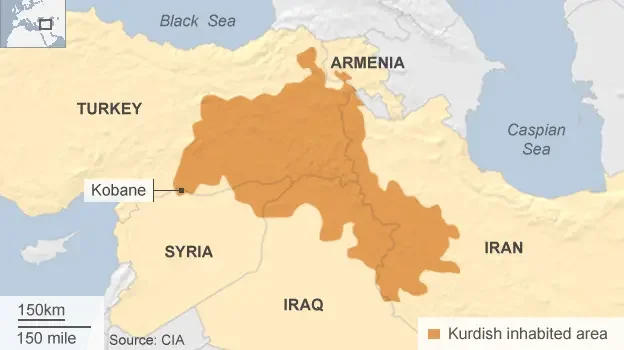
Kurdish nationalism in its various stripes across the region has been a moderating influence among the Kurds on social issues in general, most notably on issues of gender equality. The various Kurdish parties across the region including the PKK, KDP, PUK, and PYD claim to promote ideas like democracy, self determination, and social justice contributing their appeal in the West. The Kurds preference for secular politics and religious moderation made them natural allies for the US military in its war on terrorism. In turn, the Kurds have supported most of the US agenda in the region over the past several decades including the invasion of Iraq, moderate support for Israel, and the Global Coalition to Defeat ISIS.
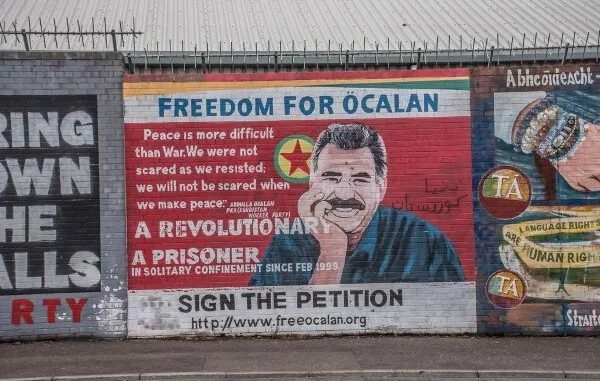
Mural Kurdish leader Abdullah Öcalan in Belfast, Northern Ireland
In Syria, the US partnered with the SDF, a coalition of Arab tribal and Kurdish forces, in its efforts to defeat ISIS in 2015. After the defeat of ISIS, the SDF was left the dominant force in eastern Syria with the weakened Assad regime unable to seriously challenge the SDF and their US allies. While Kurds only comprise about ten percent of the population in the territory it controlled, Kurdish leaders pressed for autonomy over large portions of the Deir ez-Zor, Raqqa, and Hasakah provinces hoping to reach a similar agreement with Damascus as the the Iraqi Kurds had with Baghdad. While the SDF claimed to support Democratic Confederalism, a theoretical concept of PKK leader Abdullah Öcalan; there was little democratic about the SDF’s control over eastern Syria. The SDF brutally suppressed dissent within the territory and adopting the tactics of their former tormenters, the Assad regime. Princeton lecturer Faris Zwirahn captured the dynamics of SDF rule in his recent piece for New Lines Magazine saying:
“Anyone with relatives who have joined the transitional Syrian government or forces will face frequent and random home raids and detentions. Worst of all, said Ahmad, there’s a constant fear that anyone in your daily life and social circles “could be a spy for them, as they have recently increased the number of such people significantly due to the tensions in our region caused by the SDF not integrating into the rest of the country.” This “walls have ears” paranoia was another hallmark of the Assad regime and its Baathist counterpart in Iraq under Saddam Hussein.”
The SDF’s rule eroded local trust in its ability to govern while alienating one-time allies weakening its position when the Assad regime collapsed in DEC 2024. Its Kurdish leadership overplayed their hand and rather than building inclusive institutions and public support; it fell back on its worst instincts contributing to its own undoing as Zwirahn notes:
“The suppression of fundamental freedoms like free speech, freedom of movement, political symbols and even humanitarian efforts, along with arbitrary arrests, collective punishment and the weaponization of “terrorism” charges, echoes the very authoritarian practices Syrians protested against in 2011. Far from offering a pluralistic or rights-based alternative, the SDF’s actions increased fear, self-censorship and social division, especially among Arab communities, while damaging trust and legitimacy during a crucial stage of Syria’s postwar transition.”
Another misjudgment of Syria’s Kurdish leadership over estimating its support from foreign powers, primarily the US. The US military continued to closely coordinate with the SDF in countering ISIS activity in Syria and managing the al-Hol prison camp, home to more than 7,000 ISIS detainees. Over the past year, both the US and Syrian government grew frustrated with the SDF’s maximalist demands and stalled talks. SDF leadership failed to understand its potential shifting importance toward US strategy in Syria after Damascus reached an understanding with Washington on cooperating in the fight against ISIS last year. The rise of the al-Sharaa government and the trust it has built with Washington and the Gulf Arab states contributed to the SDF’s waning support. The US pivot toward Damascus likely spelled disaster for the SDF, making it just the latest in a long-line of setbacks for the Kurdish people.