Historical Amnesia vs. Collective Memory
The looming US-Iranian War became reality this weekend after the US and Israel carried out an intense campaign of air strikes across Iran on Saturday. Iran responded in-kind launching a series of missiles at Israel, Arab allies of the US, and US positions in the region. Regardless of the US/Israeli endgame, this war seems to be at least to be a product of this administration’s historical amnesia. After campaigning on a platform of ending wars in the Middle East, the temptation of having the world’s largest military at his disposal proved to great for President Trump and his advisers. He seems to have forgotten how poorly in most respects US foreign adventurism has fared for both Americans and the region. Whatever his intentions, if President Trump is going to succeed he’ll likely have to combat the collective memory of the Iranian people. The collective psyche of the Iranian people suffers from PTSD from more than a hundred years of foreign meddling, war, and poor-to-mediocre governance. Their collective memory gives them good reason to doubt the American and Israeli intentions even if it is targeting a government they hate. They have seen the fate of American wars in Iraq and Afghanistan and they are not eager to experience one themselves. To quote an Iranian on social media, “Iran is a nation held hostage by its own regime, but haunted by the fate of its neighbors. We are stuck in a house we hate, surrounded by fires we fear more.”
The current war between the US and Iran has opened a pandora’s box concerning the future of Iran. Given the history of Iran and its neighbors, it is highly unlikely that this conflict yields a net positive result. It is also true that we won’t know the full impact of this war, for good or for bad, for years to come. The war has already resulted in the death of Ayatollah Ali Khamenei, who has ruled the country since 1987. However, if this war is going to bear fruit, at some level, Trump’s historical amnesia will have to overcome Iranians’ collective memory.
A History of Foreign Meddling
The Iranian people have good reason to be skeptical any time a foreign actor claims to act in their interests. The country’s modern history is littered with episodes dating to the late 19th century of foreign powers seeking to either manipulate or impose their will on their homeland. Following the Islamic Revolution in 1979, Iran embarked on its own campaigns of foreign meddling and adventurism seeking to spread the revolution beyond its borders through proxies like Hezbollah and becoming involved in neighboring conflicts like the US-Iraq War in 2003 and the Syrian Civil War. As both the victim and perpetrator, foreign adventurism yielded little more than the continued suffering for the Iranian people.
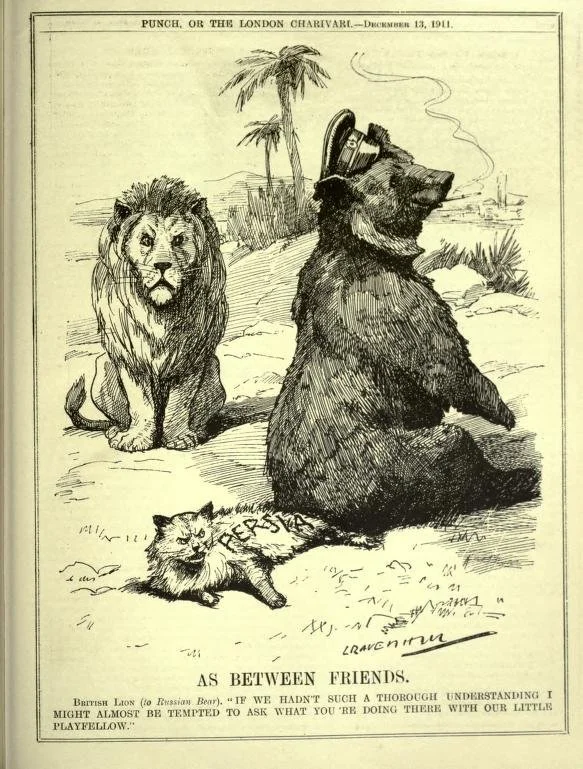
This political cartoon from the British periodical Punch displaces Britain and Russia depicted as a lion and bear playing with a Persian kitten.
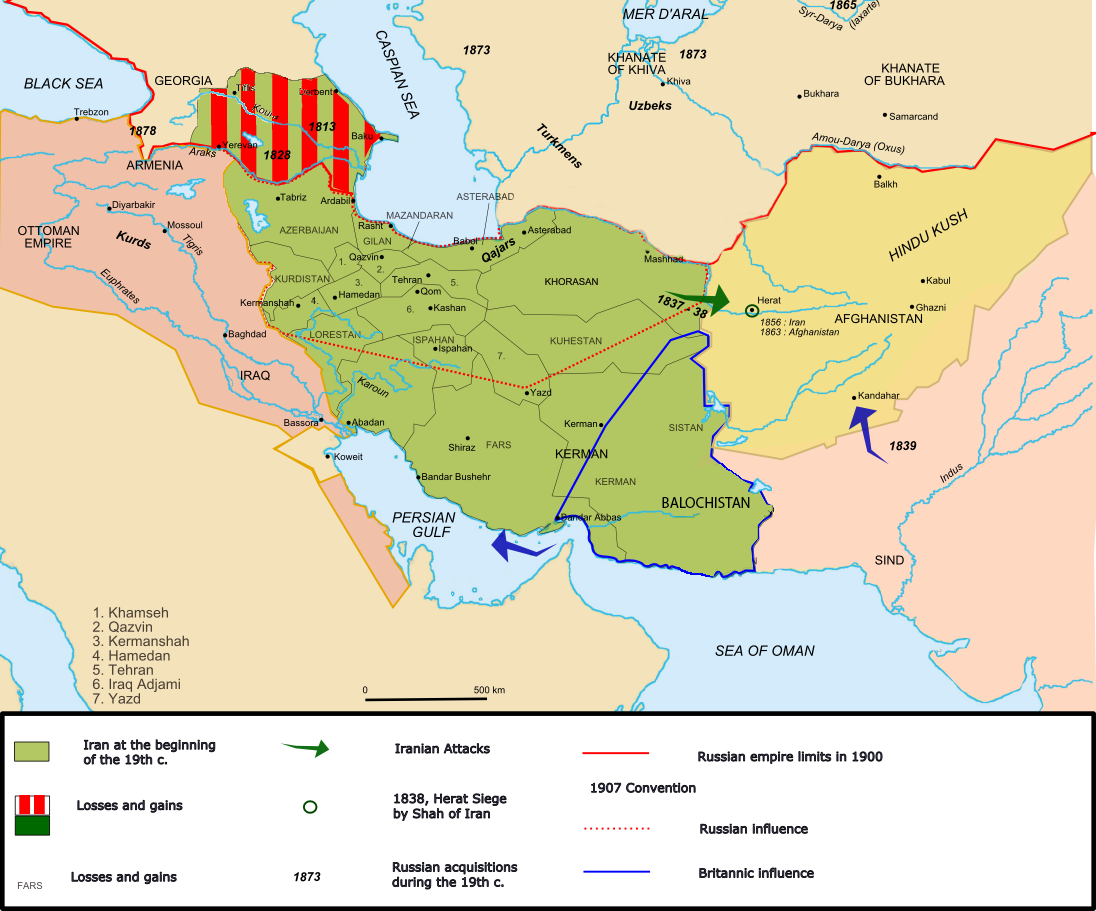
In the 1830s, the British and Russian empires saw Iran as just one of sphere of their chessboard on which they played their Great Game. Throughout much of the later half of the 19th Century, the British and the Russians bribed, manipulated, and attempted to force the Qajar shahs, who ruled Iran, to do their bidding. The British sought to maintain Iran as a buffer state between its interests in the Gulf and Russia while the Russians continued to seek access to the warm water ports of the Indian Ocean. When Russia and the British finally made amends, they did so by dividing Iran into three zones (one pro-British, one pro-Russian, and one thoroughly Iranian). The Russian and British rivalry yielded little in the way of modernization as the Qajar shahs bankrupted their “Guarded Domains” and undermined reform.
Foreign meddling was not limited to geopolitical gamesmanship. In the late 19th Century, enterprising European businessmen wooed the Qajar shahs with promises of quick riches in exchange for exclusive commercial rights to Iranian industries and resources. The two most famous, the Reuters and Tobacco Concessions, ultimately proved unworkable to the point that they were cancelled. These concessions produced foreign monopolies and provided foreign business with the rights to plunder Iran’s untapped natural resources. The most famous and long lasting concession was awarded to British-Australian businessman who secured the right to search for and develop natural gas and oil. Outbidding the Russians by £5,000, William Knox D’Arcy’s victory would lead to the discovery of large quantities of oil in 1908 and the creation of the Anglo-Iranian Oil Company (AIOC, although it was initially the Anglo-Persian Oil Company). While the D’Arcy concession would be cancelled in 1932, British domination of Iran’s oil industry would remain until the nationalization campaigns of early 1950s.
Prior to World War I, the British government purchased a controlling stake in the AIOC as it transitioned its navy from coal to petroleum power. The AIOC’s role in sustaining the British Empire and its military strength meant that British manipulation of Iranian politics would continue. From a British, and lesser extent Russian, Iranian economic and political interests would always be subordinate to the needs of the formers’ imperial interests. Between 1921-1925, the British aided a young Reza Khan in deposing the Qajar shahs and placing himself on the throne. Reza established the Pahlavi dynasty and undertook a relentless campaign of modernization meant to strengthen Iran’s independence. However in 1941, the British worried that Reza Shah’s pro-Axis sympathies could lead to Iran falling out of their control, maneuvered to force his abdication in the favor of his more pliable son Mohammed Reza Shah.
The Cold War brought a new foreign actor into Iran’s orbit, the United States. Buoyed by the wave of anti-colonial politics that swept through much of the developing world after WW II, the populist politics of Iran called for the nationalization of AIOC. Through a series of failed negotiations, Iranian nationalists led by the quasi-democratically-elected PM Mohammad Mosaddegh sought to obtain greater control over their own natural resources. In 1953, the US engineered a coup deposing Mosaddegh and empowering Mohammad Reza Shah with nearly absolute power. For 25 years, the US backed Mohammad Reza’s autocratically rule training the SAVAK, his much feared secret police, and arming his military-rule.
The Islamic Revolution in 1979 sought to reverse the tide of foreign influence in Iran. Ayatollah Khomeini and his acolytes embarked on a campaign to export Khomeini’s toxic ideology throughout the region. The establishment of the Islamic Revolutionary Guard (IRGC) contributed to the growth of a shadowy network of proxies that helped Iran become one of the leading state sponsors of terror. Some of these allies were like-minded allies like Hezbollah in Lebanon and others pragmatic partners like the Assad’s in Syria or Hamas in Gaza. In either case, the so-called Axis of Resistance earned the ire of the US, Israel, and other the Gulf states to name a few. Iran’s foreign adventurism brought with it crippling economic sanctions, geopolitical isolation, and eventually more war and death as Iranians increasingly became involved in conflicts in Iraq and Syria. Additionally, Iran spent billions arming and supporting its network of proxies and propping up the Assad regime in Syria at a time when Iran’s beleaguered economy was collapsing from within.
A History of Failed Interventions
President Trump’s decision to launch strikes against Iran is just the latest in a long line of US foreign adventures in the Middle East (with several more outside the region) stretching from the mid-20th Century to the present. Rarely have any of these worked to the advantage of the American populous. Perhaps this is why a sizable majority of Americans disprove of striking Iran. Even when the US military adventurism has yielded positive initial results they have eventually unravelled. President Trump’s decision to launch strikes in Iran is either the result of ignorance of history or the ultimate act of hubris.
In 1958, the US landed marines in Lebanon as the country teetered on the edge of civil war as Arab Nationalists pushed for union with Syria and Egypt. The US avoided fighting and buttressed the Christian Presidency of Camille Chamoun. This was the first time that American troops were deployed to the heartland of the Arab World. President Eisenhower’s decision only delayed calamity for Lebanon. By the end of the 1960s tensions between Lebanese factions brought the country to the edge of war. In April 1975, a traffic dispute between PLO officials and Phalangist politicians pushed the country over the edge into civil war. The civil war helped birth Hezbollah and introduced suicide bombing to the region which ultimately kill more than 240 marines stationed in Lebanon as part of a peace-keeping mission.
In the 1980s and 90s , US actions in both Afghanistan and Iraq would have compounding consequences that would spark decades of war and troop deployments to the Middle East. The US support for the mujahidin, Islamist fighters, helped expel the Soviets from Afghanistan. However, as the country descended into chaos afterward a new generation of Islamic fundamentalists known as the Taliban came to power. During that same period of time a relatively unknown Saudi named Osama bin Laden cut his teeth in Afghanistan and became convinced that a rough and tumble group of true believers could defeat a global super power. A decade later, bin Laden declared war on the US after the deployment of more than half a million American troops to the Arabian peninsula. Bin Laden was convinced that a new wave of American imperialism threatened the heartland of Islamic World. Bin Laden’s rhetoric was so convincing that he was able to recruit vast numbers of young Muslim men to fight the American imperialists in Iraq, Afghanistan, and elsewhere.
Perhaps more than any of its actions in the Middle East, the American invasion of Iraq in 2003 proved the most consequential. The removal of Saddam Hussein, a brutal tyrant with delusions of grandeur, seemed an obvious choice to better the region. History proved it was much easier to remove a bloody tyrant than it was to hold the country together. President Bush’s decision to invade Iraq proved detrimental to American interests. Amid the power vacuum in Iraq, Iran expanded its influence building a network of Shi’a militias that fought to thwart US efforts. The rise of the Shi’a in Iraq came at the expense of the country’s Sunnis. Frustrated and disenfranchised many Sunnis joined the ranks of the nascent ISIS.
The list goes on and on, from Lebanon to Libya and al-Qaeda to ISIS, the US has spent trillions of taxpayer dollars and spilled the blood of thousands in what feels like a never-ending war to pacify and remake the Middle East. President Trump’s decision to bomb Iran flies in the face of decades of history and US military adventurism in the Middle East. More often than not, these adventures only sow tragedy for both the US and the region. For the many Iranians who have witnessed the consequences of US foreign policy on its borders, there is a very real understanding of the unintended consequences of war. Their collective memory guards against an unfailing trust in the intentions of foreign powers. It has been forged through decades of lived experience. President Trump’s war with Iran does not seem to be grounded in the region’s history. The range of outcomes is immense and diverse, however they are more bad than good. They include regime fracture, civil war, chaos, the survival of the regime, and of course an unlikely path to democratization. Trump’s historical amnesia, extreme hubris, or both now aims to shape Iran’s future in a manner that so many in history have tried and failed.